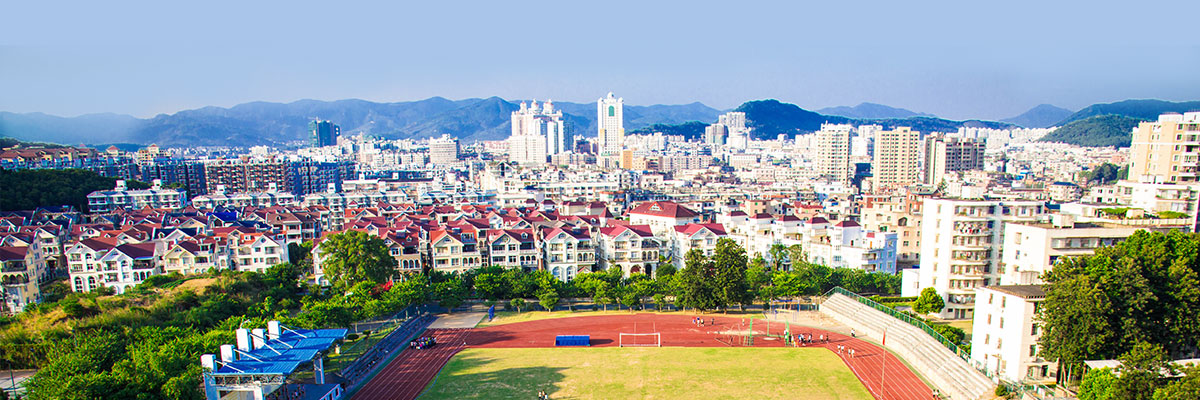
On November 15, the 2025 China-ASEAN Youth Cultural Exchange Camp, co-hosted by China Center for International People-to-People Exchange of the Ministry of Education and FPNU, officially launched. Jointly undertaken by the School of Culture and Law (School of International Education) and the School of Physical Education, the camp brought together young people from Indonesia, Vietnam, Laos and Cambodia in Fuqing, a renowned hometown of overseas Chinese, for a cross-cultural experience journey.
At the opening ceremony, Vice President Jiang Xingshan extended a warm welcome to the ASEAN youth coming from afar. He expressed his hope that during their interactions with Chinese young people, they would experience the spirit of martial arts, perceive the essence of Chinese culture, and enhance mutual understanding and friendship. Camp participants Jihan and Badri from Indonesia expressed their longing for Chinese culture in their speeches. Speaking fluent Chinese, Badri said, "Martial arts moves are fast, but they allow us to understand each other slowly." His sincere words conveyed the significance of youth exchanges and became a touching moment at the event.

The campers also toured the campus. At Baochen Library, through the collection of ancient books and thematic exhibition boards, they perceived the connotation of Chinese culture from texts and history, and comprehended the philosophy of "the integration of civil and martial virtues".
In the Situational Living Chinese Theatre activity, campers engaged in real-life shopping scenarios—using Chinese to inquire about prices and search for goods, turning what they had learned in class into practical life skills. The immersive living scenarios and interactive communication served as a bridge for cross-cultural exchanges.

In the Pingtan Comprehensive Experimental Zone, the campers participated in a themed cultural experience activity titled "Exploring the Heritage of Austronesian Peoples, Appreciating the Charm of Pingtan's Intangible Cultural Heritage". At the Austronesian Ethnic Culture Museum, following the exhibition thread of "Tracing the Maritime Silk Road", they gained an in-depth understanding of the time-honored civilizational exchanges between China and Southeast Asia, further strengthening their comprehension and recognition of the regional cultural community. The intangible cultural heritage item—Tengpai Cudgel Play—allowed the campers to truly realize that "martial arts is a cultural dialogue beyond language" as they switched between offensive and defensive rhythms. At the shell carving workshop, under the guidance of Zhan Sheng, a provincial-level inheritor of intangible cultural heritage, the campers tried their hand at traditional shell carving craftsmanship, experiencing the spirit of craftsmanship and cultural inheritance.

In the subsequent itinerary, the camp will also visit the Southern Shaolin Temple in Fuqing to explore Buddhist culture, learn Changquan (Long Fist) and dragon-lion dance skills, and hold youth dialogue sessions with students of our university. Through the integration of martial arts teaching, cultural experiences and heart-to-heart dialogues, the campers will perceive the profound heritage of Chinese martial arts in every move, and understand the openness and inclusiveness of Fujian through verbal exchanges.